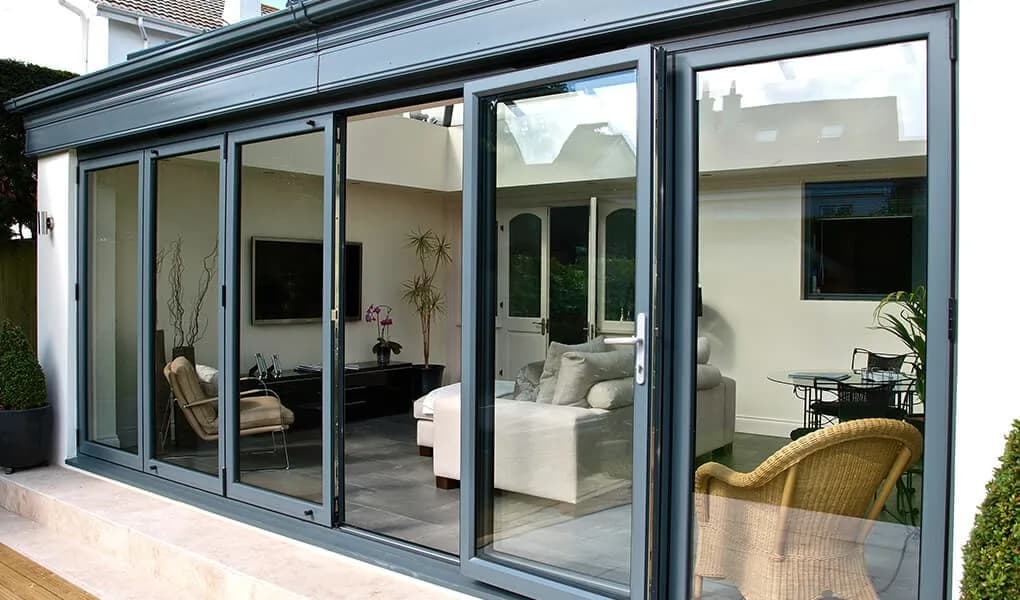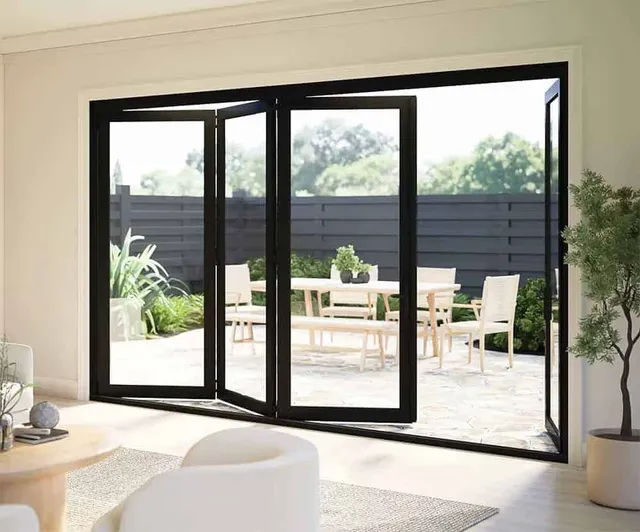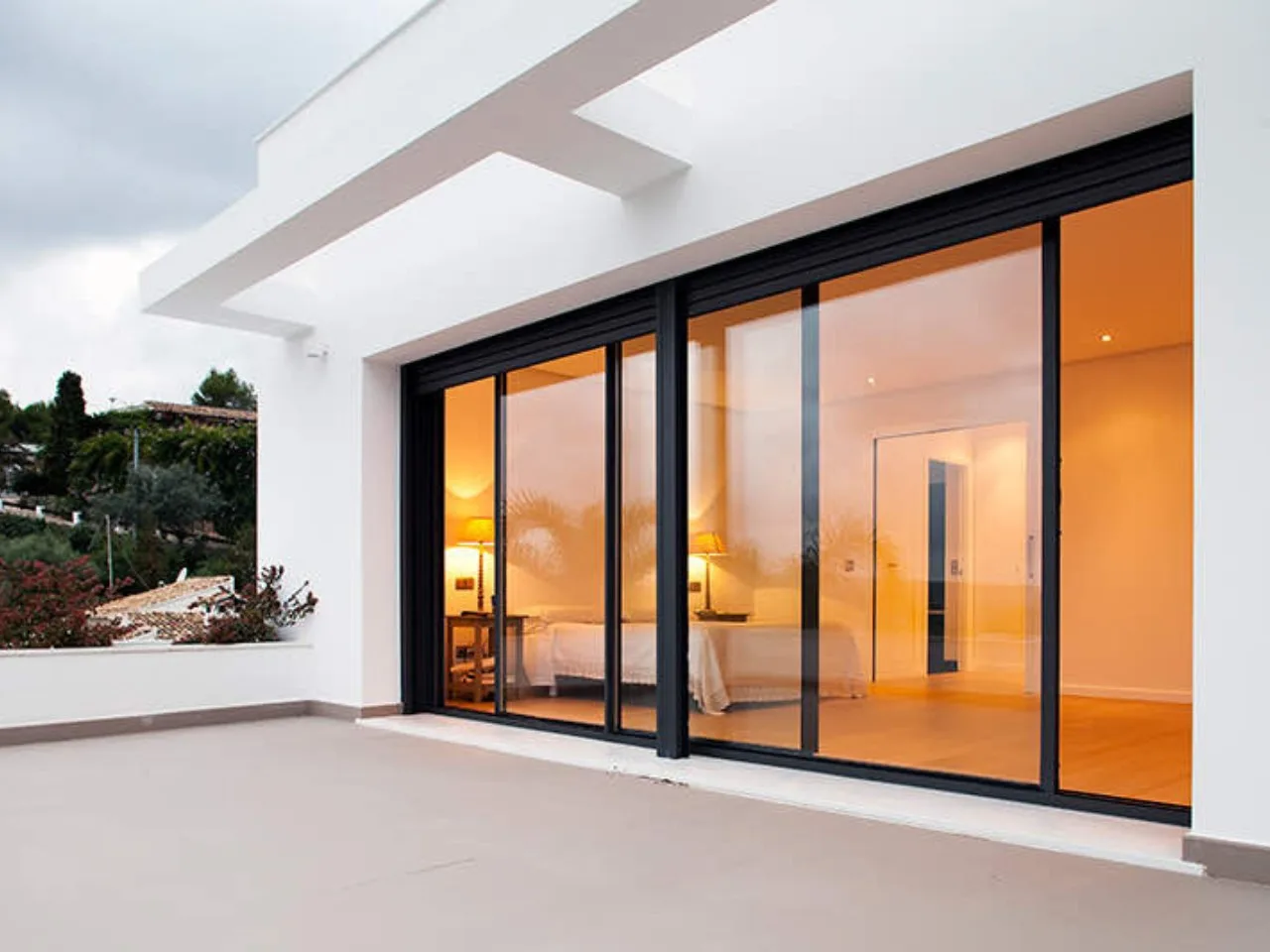
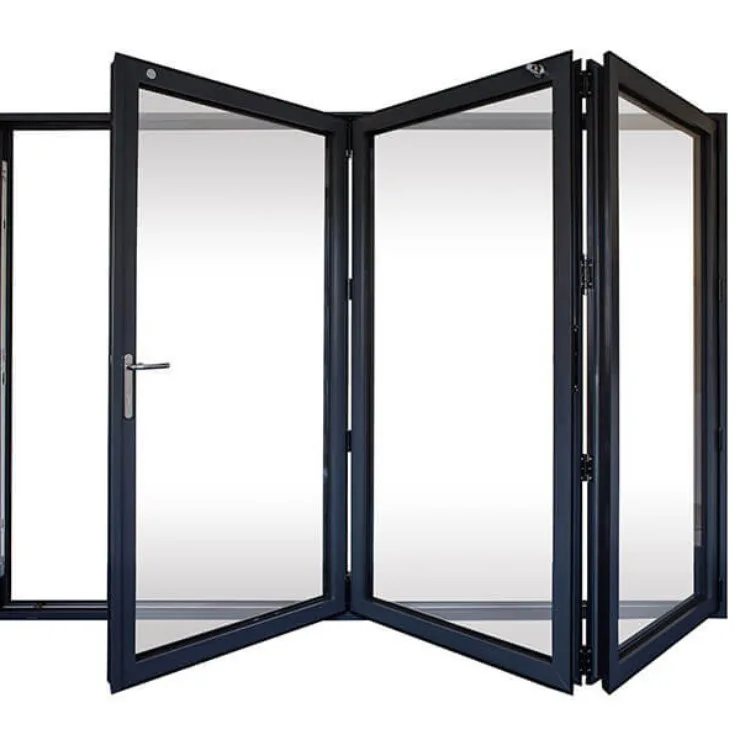
Folding door configurations are described by a short code such as 3+2 or 4+0. The numbers are the panels that stack to the left and to the right, viewed from inside. Understanding the code lets you read any supplier's drawing.
Counting panels
The opening width divided by the system's maximum panel width sets the minimum number of panels. Fewer, wider panels give a cleaner look and fewer vertical frames; more, narrower panels make lighter panels and shorter stacks. Most residential doors have three to six panels.
Odd and even numbers
An odd number of panels on one side allows a traffic door: the end panel is hinged to swing open on its own, like a normal door, without unfolding the rest. With an even number on a side, panels fold in pairs and there is no single-leaf door. For an opening used daily, specify a traffic door and place it on the side you walk through most.
Where the stack goes
Panels fold concertina-style and park at right angles to the opening. A 4+0 door stacks all panels to the left; a 2+2 splits the stack evenly; a 3+2 stacks three left and two right. Splitting shortens each stack but puts frames on both sides of the opening when open. Check what is beside the opening: a long wall takes a single stack; a corner, a worktop or a path may force a split.
Inward or outward
Outward-folding doors keep the stack outside and the inside floor clear; the main gaskets sit on the inside face, which is sheltered. Inward-folding doors are used where there is no external space, such as a balcony with a railing close to the door. Either way, the stack zone must be kept clear of planters and furniture.
Opening direction and handles
The traffic door can be hinged to open inwards or outwards independently of the fold direction on some systems and follows it on others; check the drawing. The traffic door carries the main handle and multi-point lock; the other panels have flush bolts or lever handles that release them for folding.
Reading a quotation drawing
A good drawing shows the configuration code, the fold direction, the traffic door with its swing, the stack zone dimensions, the threshold type and the clear opening when folded. If any of these is missing, ask for it before ordering. See the folding doors page for the full set of options.